
From the Archives: Local Woman Sets Out To Save Monarchs and Loses a Shoe
This story was originally published on July 2nd, 2021, on ChicagoNow, a Chicago Tribune sister site, during a summer when I had set the rather ambitious goal of raising 500 monarch butterflies to distract myself from a few curveballs life had thrown at me.
A great deal has changed since then. I no longer raise monarchs in those numbers and actually strongly advise against it. Instead, I raise a few monarchs for education and awareness. The jury is out on the ethics of raising monarchs, but, like with everything else in our day-to-day life, moderation is best. My life also looks different in more ways than I could have imagined when I first wrote this. Despite all that has changed, the muddy adventure, the broken sandal, and the determination behind it still make me smile.
I have lightly edited the original version for clarity while preserving the voice—and the chaos—of that particular chapter of my life.
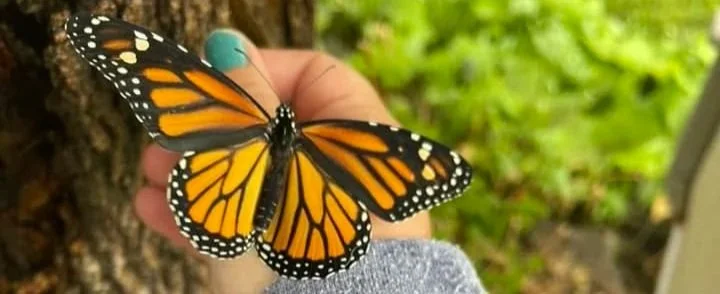
8/4/2023- Releasing a female monarch
First, allow me to admit that it’s me— I’m the local woman. It all started two years ago when my aunt gave me 5 microscopic monarch eggs to take back to my apartment in Virginia. I raised them from eggs to caterpillars, to chrysalises, and finally to beautiful black-and-orange butterflies. I was hooked.
Last year, I raised 80. This year? I’m setting out to raise 500. Why? Well, for one, I’m not doing anything else this summer but writing to you lovely folks, walking 30,000 steps a day, working my main job, and my side hustle slinging nail polish. It’s not like all of that keeps me busy or anything. Hey, this is what happens when you are 35, single, childless, and live in a 280-square-foot recreational vehicle. Oy.
So as anyone in Chicagoland may have noticed over the last, well, what feels like FOREVER, we have had SO. MUCH. RAIN. It never stops. But the quest to raise 500 monarchs must go on. Not only do I have to go out daily and collect eggs, but I also have to collect milkweed to keep these hungry little caterpillars fed. That book was no joke. These little yellow and black striped critters eat, and eat… and eat. So three days ago, there was a break in the rain, which made it the perfect time to go out and look for eggs.
The only issue is I’ve already reached all the milkweed in walking distance along the road on our 120-acre farm, so on this specific day I thought I better head out to the fields in search of more flutter butter friends. Great Idea. NOT. After a .75 mile walk to the south end of the farm, I made a turn to walk around the back of the farm. I was slightly worried about the mud I might encounter, but after the first 10 feet or so I realized it wasn’t so bad! Then I walked another 10 feet and down about 8-12 inches, my feet slid into the slimy, quite stinky, tilled slop. I hadn’t even made it to my first milkweed plant yet, and my feet were already covered in mud, so I trudged on.
I found some milkweed, walked up the side of the farm to less-muddy land, and looked down. There had to be two inches of mud covering my feet and legs in all directions. Now that I was walking on grass, things got even more precarious as what I can only describe as a five-year-old's mud pie developed on the bottom of my $150 Teva sandals.
Let me explain to you how important these sandals are to me. I’m cheap when it comes to clothes and shoes. I don’t know a thing about fashion. In 2018, I was going to Spain. It would be hot. I would be walking A LOT, and I needed practical shoes. After spending forever in shoe stores trying to find hiking sandals that didn’t feel like a straitjacket, I came across this black pair of Tevas. I’m not a name-brand person by any means, but boy, these sandals fit like a glove. I looked at the price tag. $150. About $130 more than I have ever spent on a pair of shoes in my lifetime.
But don’t worry, since Spain, I have worn this very pair of shoes every single day unless I was at work, in my bed, or there was more than a dusting of snow on the ground. I kid you not, these shoes have been on my feet more than they were not over the last three years. And beautifully did they hold up. That was until I walked back down in the mud and decided to walk a little further. The more I walked between the grass and mud, the heavier my feet became to lift. I mean, great workout and all, especially since every step I took was basically one of those knee-up things people who work out do. Yeah, I’m not a fitness guru.
Then the unthinkable, unimaginable, and heartbreaking happened. I pulled my foot up out of the mud, and my sandal was gone. GONE. I didn’t want to lose the other one, so I sank my hand into the firm soil under the slop, grabbed the shoe, and stood shoeless. Next, I would need to find the shoe. I searched and searched in the mud for the counterpart to the left shoe sitting next to me. It took a while, but after losing one of my most precious possessions, I found it… with the strap broken. My heart sank, but I had to go on. I held what felt like 20 pounds of dirt and shoes in my hand as I walked further through the mud. I felt a bit like a child as I made my way from one milkweed plant to the next.
Of course, the rain returned, so I made the mile-long trek back home, barefoot. I stopped at the hose with my 38 monarch eggs and 15 large milkweed leaves to rinse my shoes and legs. I swear when I jumped in the shower a few minutes later, I even found mud in my hair. And you know what? I have worn the sandals, broken strap and all, every day since. Maybe it’s time for a new pair? Eh. I think I’ll ride these out as long as I can. Plus, in about 24-28 days, I’ll have 38 beautiful monarchs to show for it.
Priceless.
I never did stop caring about monarchs. What has changed is how I understand my role in helping them.
These days, my focus is less on collecting hundreds of eggs and raising caterpillars and more on creating a place where monarchs can complete their migration on their own. I grow four types of milkweed and a dozen nectar plants, avoid anything that could harm monarchs or other pollinators, and try to make room for the wild creatures that share this little patch of earth with me.
My life has changed, too. Some of the jobs, goals, and circumstances mentioned in this story belong firmly to an earlier version of me who was going through the hardest time of her life. But the woman willing to walk barefoot through a muddy field for monarch eggs? She is still here—her mission has just grown deeper roots.
Follow more about my journey with Wildlife here.
